


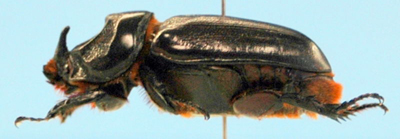
I’m a fan of beetles, it’s sad that the beetles are harming one of Guam’s best natural resources. I’m glad there are there are scientists like Cathleen Moore-Linn to work on a solution.
In May 2008 the island of Guam became a living laboratory for scientists as they attached acoustic equipment to coconut trees in order to listen for rhinoceros beetles. A grant from USDA IPM allowed Richard Mankin, a recognized world-class expert on acoustic detection of insects, to travel to Guam to collaborate with island scientists on the Guam Coconut Rhinoceros Beetle Eradication Project. The results of this research were recently published in the journal Florida Entomologist.
The coconut rhinoceros beetle, Oryctes rhinoceros, is a serious pest of coconut palms and was discovered on Guam September 11, 2007. University of Guam entomologist, Aubrey Moore worked with Mankin to analyze the spectral and temporal patterns of stridulations produced by the rhino beetles. Recordings were made of beetles and larvae that were reared at the university. Field recordings were also made of beetles and larvae in coconut trees and logs.
Digitized signals were analyzed with several types of software, which distinguished intervals and amplitudes of chirps. The stridulations have distinct, easily recognizable temporal patterns. Results of these studies favor the hypotheses that beetles use stridulations to communicate with other beetles in hidden environments and that acoustic monitoring devices can be useful in mitigating the damage to coconut trees through monitoring and early detection.
“This method of acoustic detection allowed Guam ‘rhino hunters’ to quickly and efficiently locate feeding grubs in an area thought to be rhino-beetle free,” says Aubrey Moore, “and as the beetle broadens its range the acoustic approach to detection may save money and the lives of many coconut trees.”
http://www.eurekalert.org/pub_releases/2009-04/uog-grb041309.php